FLOW · Special Report · September 2026
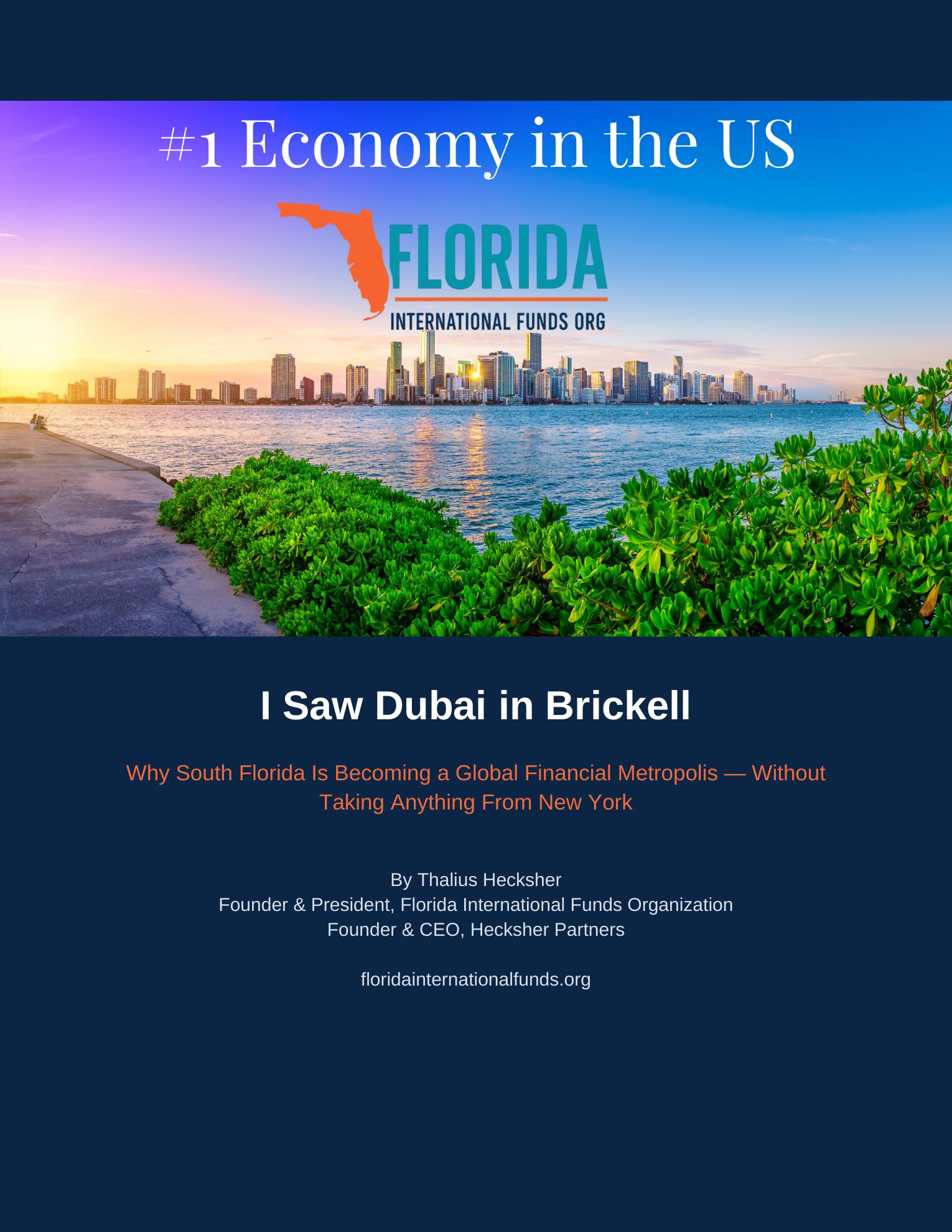
I Saw Dubai in Brickell
Why South Florida is becoming a global financial metropolis — without taking anything from New York. Thalius Hecksher reflects on Miami's evolution, the capital and talent reshaping the region, and the work still required to become the financial capital of the Americas.
Full report
STANDING ON BRICKELL AVENUE
The first time I stood on Brickell Avenue, I had the strangest feeling that I had seen it before.
I had. In 2001, while heading up the asset management division at Reuters, I visited Dubai. Back then there was the Burj Al Arab, the wave-shaped Jumeirah Beach Hotel, and one long road running through the desert. Everything else was sand, and a city on the cusp of something extraordinary.
Standing in Brickell, I saw the same thing: cranes on the skyline, half-finished glass towers, money arriving from three continents, and a city that had not yet decided what it wanted to be. Miami looked the way Dubai must have looked a generation earlier, before the world noticed.
I was based in Dublin at the time, leading global business development for Apex Fund Services, and Miami was a three-day stop sandwiched between meetings in Brazil and Europe. Over dinner on Brickell Avenue, Michael Corcelli of the Florida Alternative Investment Association told me I should think about relocating. I laughed. Miami was not on my radar.
It is the best advice I have ever been given.
"WALL STREET FLEES NEW YORK"
On a flight back to Dublin in November 2011, I had what I still call a hare-brained idea: I was traveling in the wrong direction. Three months later, my family of five moved to Fort Lauderdale, and Apex opened an office in Miami to serve Latin America and a hedge fund community that was quietly taking root in South Florida.
The New York Post picked up the story under a headline that followed me for years: "Wall Street flees New York for tax-free Florida." What I told the reporter then, I still believe now. "Florida is a state of choice. It's organically grown. There's no need to drag people down here."
The coverage, along with a CNBC interview, landed in Tallahassee. Governor Rick Scott, who had campaigned on treating Florida as a turnaround opportunity, wanted to understand what financial firms needed to come south. I attended several of his fundraisers, and we had a long phone call about what we were doing at Apex to build and support the asset management community. The Governor was focused on raising median wages, and he saw finance as one of the surest ways to get there. That instinct has aged well: today, finance pays the highest average wage of any industry
in South Florida. Around the same time, the Palm Beach County Business Development Board launched its own campaign to attract financial services firms.
Later, Fox Business invited me onto Varney & Co. as a guest to explain why I had moved my family and my business to South Florida. The short version of my answer has not changed: Florida is a state of choice, and the people and capital coming here want to be here.
In 2012, Florida had sunshine, a zero income tax and a growing Latin American banking corridor. What it lacked was structure: the associations, the service providers and the community that a financial center needs. Building that became my second job.
THIS WAS NEVER ABOUT BEATING NEW YORK
From the start, I have said one thing that surprises people: South Florida will not take anything away from New York.
The headlines framed it as an exodus. I saw it as an expansion. Dubai did not hollow out London. Singapore did not empty Wall Street. Each became a new node in the global financial network, serving a region and a time zone the older centers could not reach as well. The pie grew.
The scoreboard backs this up. In the September 2026 Global Financial Centres Index, New York still ranks first in the world, ahead of London, Hong Kong and Singapore. Meanwhile Dubai climbed to seventh in March 2026, its highest ranking ever. Both things are true at once. That is what a growing financial world looks like.
Miami's natural role is the same: the financial capital of the Americas. It is the hinge between New York's capital markets and Latin America's growth, a short flight from São Paulo, Bogotá and Mexico City, in the same time zone as Wall Street.
WHY IT WAS ALWAYS GOING TO BE MIAMI
The wave that arrived after 2020 landed on a city that had spent six decades learning how to receive money, people and businesses from somewhere else.
It began in 1959. After Fidel Castro took power, hundreds of thousands of Cubans crossed fewer than 150 kilometres of water, and Miami's Hispanic population grew from roughly 50,000 in 1960 to 580,000 by 1980. Many were professionals and entrepreneurs who founded banks, businesses and newspapers that could operate in both the American and Latin American worlds. From the late 1970s, changes to Florida banking law made it easier for foreign financial institutions to open offices, and within two decades international banking had become a major Florida industry. Later waves from Venezuela, Colombia, Argentina and Brazil deepened those ties.
The result is something no other U.S. city has: a place legally and financially inside the United States, but culturally and geographically at the doorstep of Latin America. Miami International Airport offers more flights to Latin America and the Caribbean than any other U.S. airport, handled
more than 55 million passengers in 2025, and leads the country in international freight. More than 1,000 multinationals run their Latin American operations from South Florida, next to a region of over 650 million people.
That is why I never believed Miami would replace New York. New York's influence runs in every direction. Miami's advantage is more specific: a bilingual American financial center where companies raise money inside the U.S. system while keeping direct relationships across Latin America. Like Dubai at the crossroads of Europe, Asia and Africa, it wins by being the hinge.
THE NUMBERS BEHIND THE INSTINCT
What I saw in 2010 was a feeling. What we have now is data, and it describes one of the largest voluntary transfers of earning power in modern American history.
The money followed the people. In the latest IRS migration data, Florida gained a net $20.6 billion in adjusted gross income from people moving in from other states, more than three times second-place Texas. New York lost $9.9 billion that same year. Over the five years from 2019 to 2023, Florida's net income inflow reached $137 billion, and over the last decade roughly $196 billion, while New York lost about $111 billion.
The people are high earners. Tax filers who moved to Florida in 2023 reported an average income of $122,530, the highest of any state. On net, Florida gained 29,771 households earning $200,000 or more, adding $28.7 billion in income. The Citizens Budget Commission found that New Yorkers who moved to Miami-Dade in the five years through 2022 had per capita incomes of about $266,000.
The 2021 inflection. The pandemic loosened the tie between high earners and head offices in New York and Chicago. In 2021 alone, households moving into Miami-Dade brought $10.4 billion in adjusted gross income, 131% more than the year before. Across Southeast Florida, domestic migration added a net $15.9 billion in household income that year.
Palm Beach is the national leader. Palm Beach County now ranks first among all U.S. counties for net income inflow from domestic migration, at $22.7 billion. Its financial sector pays an average annualized wage of $172,588, the highest of any industry in South Florida.
The jobs are real. Miami-Dade was Florida's largest private-sector job creator in 2025, adding 10,608 jobs, led by financial activities (up 4,605, or 5.5%). The county has added more than 102,000 private jobs since 2019. Florida Atlantic University reported in August 2026 that Miami-Dade's finance and insurance wages grew 9.8% year over year.
The honest part. Median household income tells a slower story. In Miami-Dade it was $71,753 in the 2024 Census estimates, and inflation-adjusted growth from 2010 to 2021 was only about 6%. The wealth arriving at the top has not yet lifted the middle. Any serious case for South Florida has to say that out loud.
BRICKELL TODAY: FROM BANK BRANCHES TO A FINANCIAL DISTRICT
The Brickell I walked in 2010 was a corridor of bank branches and rental towers. Today it is becoming a true financial district.
The skyline tells the same story. A recent video essay, Why Miami Is Building So Many Luxury Skyscrapers, calls Miami the new American epicenter of skyscraper construction. The Cipriani Residences topped out at roughly 290 metres in July 2026, the Okan Tower will reach 275 metres, and the 320-metre Waldorf Astoria will be Miami's first supertall. Three of the seven tallest buildings under construction in the United States stand within a few kilometres of each other here.
The scale goes well beyond a few landmarks. The Downtown Development Authority counts more than 30 major projects in the urban core, and Southeast Florida entered 2026 with more than 36,000 apartments under construction, more than any other U.S. metro. For most of its history, flight paths into Miami International kept the city low; its first building above 200 metres, the Four Seasons, only opened in 2003. The unspoken assumption was that Miami was famous, but not a global business capital.
One observation in that video stopped me. Miami's new towers are overwhelmingly homes and hotels, not offices, which makes its skyline look less like a traditional American downtown and more like Dubai or Singapore, where luxury property is both a residence and a store of wealth. That is exactly what I saw in 2010. By July 2026, more than 80% of the Cipriani residences had sold, a year before delivery. Global capital is buying its place in Miami's future before that future is finished.
The early movers came first. Starwood Capital moved from Greenwich to Miami Beach in 2018. Then in 2022, Ken Griffin announced that Citadel and Citadel Securities would move their headquarters from Chicago to Miami. Citadel is now building its global headquarters at 1201 Brickell Bay Drive, a Foster + Partners supertall reported at around $2.5 billion, and in July 2026 it expanded its planned footprint to roughly 561,000 square feet.
What matters most is not one firm but the cluster forming around it. The tenant list at 830 Brickell includes Citadel, Microsoft, Kirkland & Ellis, Thoma Bravo, Sidley Austin and Banco Santander. Hedge funds, private equity, banks, law firms and technology companies are choosing the same few blocks. That is how financial centers are built: not by one headline, but by an ecosystem that makes the next move easier.
This is the part of the Dubai story people forget. The towers were only half of it; the institutions, the rules and the service providers are what made them matter. Brickell is now in that phase.
WHAT DUBAI TEACHES US ABOUT THE GAP
If Miami is where Dubai was 30 years ago, it is worth being clear about the distance still to travel.
Miami does not yet appear in the global top 20. In the September 2026 Global Financial Centres Index, the North American centres in the top 20 are New York, San Francisco, Los Angeles, Chicago, Boston and Washington. Dubai, by contrast, did not arrive by accident. It set a public goal of becoming a top-four financial centre by 2033 and built the Dubai International Financial Centre, with its own courts and regulation, to get there.
South Florida has five gaps to close:
• Talent. Relocations move existing employees; they do not create new ones. Local universities produce roughly 1,200 finance graduates a year, far short of what the new firms need. • Affordability. A median household income near $72,000 does not stretch far in Brickell. Since 2014, roughly 62% of Miami-Dade renter households have spent more than 30% of their income on housing; among renters earning under $50,000, the figure tops 91%. If teachers, nurses, hotel staff and junior analysts cannot live near the jobs, the ecosystem stalls. • Froth. In 2025, the UBS Global Real Estate Bubble Index ranked Miami the highest bubble risk of the 21 cities it studied. Miami remembers 2008, when pre-sold condos became discounted inventory. This cycle is backed by a genuine migration of people, companies and capital, but prices now depend on that flow continuing. • Resilience. Miami-Dade plans for sea levels 10 to 17 inches above 2000 levels by 2040, and satellite data from 2016 to 2023 found subsidence at many coastal towers between Miami Beach and Sunny Isles. The city has committed $192 million from its Miami Forever bond to flood prevention. Dubai built its future on sand; Miami must build its future on water. • Institutions. Singapore and Dubai have regulators, exchanges and dispute-resolution bodies that anchor global capital. Miami still leans on New York and Washington for most of that plumbing.
None of these is a reason for doubt. They are the to-do list.
TOMORROW: THE FINANCIAL CAPITAL OF THE AMERICAS
Here is what Florida offers the global economy that no other place can.
• A gateway. Miami sits between North and South America, bilingual by default, in New York's time zone, with more flights to Latin America than any other U.S. airport. For a fund in São Paulo or a family office in Madrid, it is the natural front door to U.S. capital markets. • A tax and regulatory climate that rewards building. No state income tax is the headline, but the deeper advantage is a state government that has treated finance as an industry to recruit for more than a decade. • Momentum that compounds. Every firm that arrives makes the next decision easier: more lawyers, more auditors, more administrators, more talent, more deal flow.
• Quality of life as strategy. Firms compete on talent, and talent now chooses where to live first and where to work second.
When I told people in 2012 that South Florida could become a financial metropolis in its own right, standing alongside New York rather than against it, some thought I was selling sunshine. Fourteen years later, Citadel is building a supertall on Brickell Bay, Palm Beach leads the nation in incoming wealth, and Miami-Dade is Florida's biggest job engine.
Dubai took about 30 years to go from a skyline of cranes to the global top 10. South Florida is roughly halfway through its own version of that journey. The question is no longer whether it happens. It is whether Miami can turn capital that comes here to shelter into an economy where wealth is created and stays, with the talent, the housing, the coastal protection and the institutions to make it last.
I am betting that we will.
JOIN THE ROOM WHERE IT HAPPENS
Every financial center runs on rooms where the real work gets done: where a manager meets an allocator, a founder meets a fund administrator, and a New York lawyer meets a family office from São Paulo. Dubai built those rooms inside the DIFC. In Florida's asset management community, that room is the Florida International Funds Organization (FIFO).
FIFO brings together hedge funds, private equity firms, family offices, institutional investors, banks, law and accounting firms, and the service providers that support them. Through events, partnerships and thought leadership, including its February 2026 partnership with South Florida Business & Wealth, it gives firms arriving in Florida immediate access to a trusted community instead of years of cold introductions.
When I arrived in 2012, that room did not exist, so we built it. We founded FIFO, I serve as its President, and over the last 12 to 14 years we have run and hosted more than 120 events for Florida's asset management community. If you manage capital, allocate it or serve those who do, and you are building in Florida or thinking about it, join us at floridainternationalfunds.org.
Thalius Hecksher is the founder and CEO of Hecksher Partners, a global asset management consultancy supporting firms with go-to-market and U.S. growth strategies, including U.S. onshore and offshore advisory services. He is also the founder and President of the Florida International Funds Organization. He relocated from Ireland to South Florida in 2012.
SOURCES
• Florida Trend: 30-somethings making their mark across Florida (2014) • Repost of the NY Post "Wall Street flees NY" story (2013), 4closurefraud.org • Florida Realtors: IRS data shows income migration continues to favor Florida (June 2026) • Tax Foundation: State migration trends; How taxes affect interstate migration
• MIAMI Realtors: Palm Beach County #1 in net income inflow (March 2026); Miami ranks No. 1 for private employment growth (June 2026) • National Taxpayers Union: Florida continues to attract new residents • Fortune: New Yorkers moving to Palm Beach and Miami-Dade • FAU: South Florida labor market shifts (August 2026) • Florida Demographics and Neilsberg: Miami-Dade County income data • KiTalent: Miami financial services hiring in 2026 • Capital Analytics: Citadel supersizes its Miami HQ (July 2026); 22Miami: Citadel's Miami HQ and the Brickell corridor • Z/Yen: Global Financial Centres Index 40 (September 2026); DIFC: Dubai advances to 7th in GFCI (March 2026) • Video: Why Miami Is Building So Many Luxury Skyscrapers (YouTube) • FIFO and South Florida Business & Wealth partnership announcement (February 2026)
FIFO members get curated introductions and invitations to our private roundtables.
Apply for Membership →GET FLOW EVERY WEEK.
Florida's capital flows, talent moves and deals, in five minutes.